
Achieving State-of-the-Art UAV Tracking on the Anti-UAV Benchmark: Innodata Results
Frank Tanner, VP of Computer Vision and Robotics
January 9, 2026
Tracking unmanned aerial vehicles has become a critical challenge for aviation safety, security, and defense organizations. UAVs are now linked to a growing number of near midair collisions around major airports and repeated disruptions of airport operations¹ ². At the same time, small UAVs have become central to modern warfare, particularly in Ukraine, where inexpensive drones are deployed on a massive scale and have transformed the conflict into a proving ground for new battlefield tactics and autonomous systems³ ⁴ ⁵.
These developments have elevated UAV tracking from a niche technical problem to a real-world operational requirement. Detecting and tracking small, fast-moving objects in noisy visual environments places extreme demands on computer vision systems, especially when reliability and low false alarm rates are non-negotiable.
The research community has responded accordingly. CVPR has hosted an Anti-UAV track for the past five years, complete with a dedicated benchmark and public leaderboard for drone tracking models (https://anti-uav.github.io/). At Innodata, we have developed deep expertise in identifying small objects and building algorithms that can reliably detect and track targets under challenging, real-world conditions.
Putting Our Expertise to the Test
Given Innodata’s experience with small-object data and the growing importance of UAV tracking, I decided to run a series of experiments using the published Anti-UAV benchmark to evaluate how far we could push our tracking pipeline.
The dataset spans a wide range of scenes and sensor modalities, including RGB and infrared video. Drones in the dataset can appear as large as approximately 11,000 pixels in a frame or as small as just 12 pixels. Roughly 69 percent of labeled objects fall in the 1,000 to 5,000 pixel range, about 25 percent are between 500 and 1,000 pixels, and only a small fraction are either very large or extremely small. This long tail of small targets is exactly where many tracking systems begin to fail, making the benchmark a particularly demanding test of both sensitivity and robustness.
Benchmark-Leading Performance on the Anti-UAV Dataset
On Track 1 of the Anti-UAV benchmark, Innodata’s current tracking pipeline exceeds previously reported results on the published test set by 6.45 percentage points. This includes surpassing strong baselines such as SiamSRT (Huang et al., 2024)⁶ and related Siamese-network trackers that have dominated thermal infrared drone tracking in recent years⁶ ⁷ ⁸.
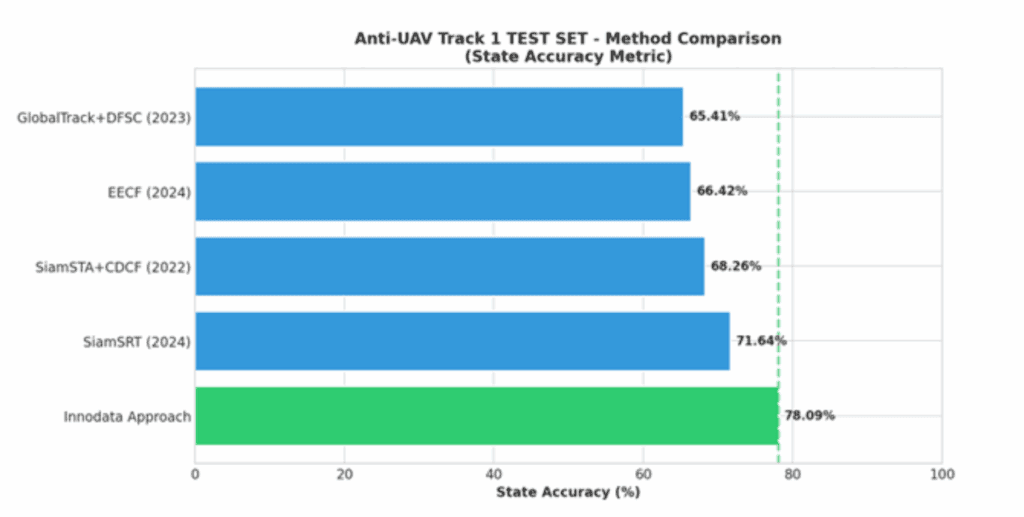
Figure 1. Innodata’s approach compared with other published results on the Anti-UAV Track 1 benchmark.
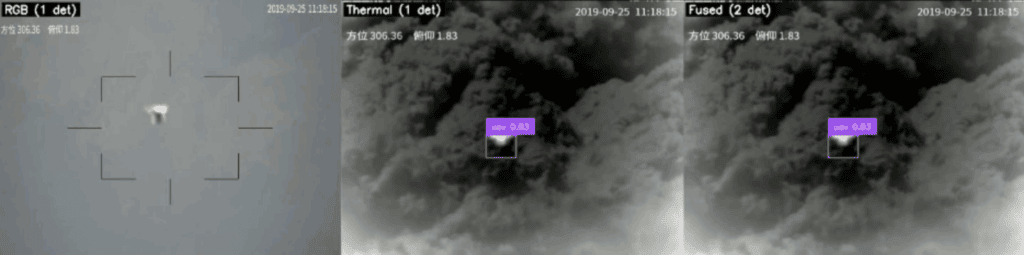
Figure 2. Detection demonstration across infrared and combined IR+RGB video frames. Full video available via provided link.
On Track 3, our multi-object tracking setup achieves strong performance across accuracy, precision, and recall, backed by thousands of true positives and only a handful of false alarms. In practical terms, the system does not just detect drones. It detects almost all of them, almost all of the time.
Key Performance Highlights (Track 3)¹
- MOTA: 94.76 percent (Multiple Object Tracking Accuracy)
- Precision: 99.74 percent (minimal false positives)
- Recall: 95.01 percent (captures nearly all UAVs)
- Average IoU: 78.87 percent (tight bounding boxes)
- Detection statistics: 2,304 true positives, 6 false positives, and 121 false negatives
¹ Track 3 metrics are evaluated against a sequestered portion of the validation set, as the full test set is not publicly available.
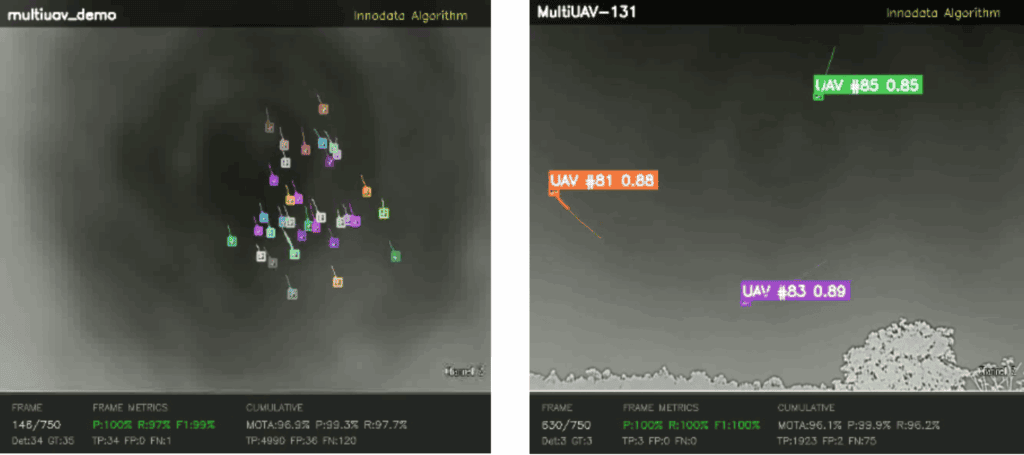
Figure 3. Sample frames from Innodata’s multi-object tracker. Full demonstration videos can be found here for the left, and here for the right.
Real-World Flexibility
In operational settings, benchmark accuracy alone is not sufficient.
The same tracking pipeline described here can be tuned for deployment on SWaP-constrained edge devices, optimized for maximum probability of detection, or configured for ultra-low false alarm rates depending on mission requirements. Whether the use case involves protecting critical infrastructure, monitoring airspace around airports, or deploying on resource-constrained platforms in the field, the system adapts to operational needs.
While the tracking system is primarily focused on infrared channels, it generalizes effectively to RGB and combined RGB+IR sensor configurations, making it suitable for a wide range of deployment scenarios and sensor suites.
What This Means
As UAV threats continue to grow in both civilian and military contexts, reliable high-performance detection and tracking capabilities are becoming essential. These benchmark results demonstrate that Innodata’s approach delivers the level of accuracy and robustness required for real-world deployment, whether securing an airport perimeter, protecting a military installation, or monitoring critical infrastructure.
Interested in learning more about Innodata’s UAV detection and tracking capabilities? Contact Innodata to discuss how this technology can support your specific operational requirements.
References
- Scripps News. Drones linked to most near midair collisions at 30 US airports. April 20, 2025.
- AP News. Drones pose increasing risk to airliners near major US airports. April 22, 2025.
- Hudson Institute. The Impact of Drones on the Battlefield: Lessons of the Russia-Ukraine War. November 12, 2025.
- Arizona Center for Investigative Reporting. Ukraine’s “battle-tested” drones and militarization. December 16, 2025.
- War on the Rocks. Gamified War in Ukraine: Points, Drones, and the New Moral Economy of Killing. January 6, 2026.
- Huang et al. (2024). Searching Region-Free and Template-Free Siamese Network for Tracking Drones in TIR Videos. IEEE TGRS.
- Huang et al. (2022). Learning Spatio-Temporal Attention Based Siamese Network for Tracking UAVs in the Wild. Remote Sensing.
- Wu et al. (2024). Biological Eagle-Eye-Based Correlation Filter Learning for Fast UAV Tracking. IEEE T-ITS.

Bring Intelligence to Your Enterprise Processes with Generative AI.
Innodata provides high-quality data solutions for developing industry-leading generative AI models, including diverse golden datasets, fine-tuning data, human preference optimization, red teaming, model safety, and evaluation.

Follow Us