

Trace Datasets for Agentic AI: Structuring and Optimizing Traces for Automated Agent Evaluation
Agentic AI refers to multi-agent systems that plan and execute complex goals, using role-based orchestration and persistent memory. Through trace datasets and automated agent evaluation, enterprise AI leaders, platform and governance owners can manage operational challenges at scale, reducing costs, improving reliability, and ensuring compliance.
Traditional input–output evaluation assumes intelligence is expressed in a single response. However, agentic AI’s intelligence is reflected in the sequence of decisions, actions, retries, and adaptations that lead to an outcome.
The Enterprise Challenge
In agentic systems, this loss of visibility is a material business risk, not a minor evaluation gap. For teams responsible for deploying and governing agentic AI in production, limited insight into agent behavior directly impacts operational cost, incident response time, and regulatory risk. Using traditional evaluation approaches, enterprises cannot understand:
- How decisions were made
- Where failures originated
- Whether systems are reliable, safe, and compliant
Trace datasets and automated agent evaluation together form an enterprise-ready foundation for evaluating and improving agentic AI systems. By converting raw agent execution into a repeatable pipeline from traces to structured datasets to automated evaluation, enterprises gain the observability and governance capabilities required to operate agentic systems with confidence at scale.
This article covers:
- What agent traces look like in practice
- How the agent traces are structured into evaluation-ready trace datasets
- How those datasets enable automated agent evaluation, and
- How evaluation results feed into observability and governance workflows
Traditional Evaluation and Its Limits in Agentic Systems
Traditional evaluation assesses the relationship between an input and its resulting output using metrics such as accuracy, relevance, and correctness.
In agentic systems, this approach captures what happened but not how it happened, creating gaps in transparency, accountability, and trust. For example, two agents may produce the same output while following very different paths, with different costs, risks, and failure modes.
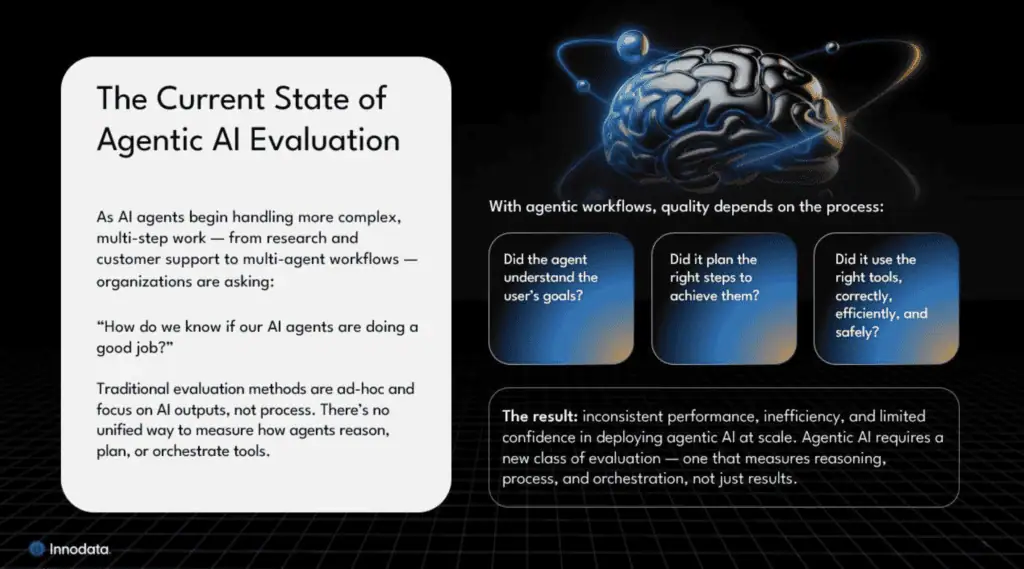
Agentic evaluation requires accounting for:
- Multi-step reasoning and planning
- Tool usage and orchestration
- Partial failures mid-execution
- Retry and recovery logic
- Multiple agents coordinating
Without measuring these behaviors, enterprises cannot reliably diagnose errors, compare agent performance, or enforce policies.
Trace Datasets in Agentic AI Systems
A trace dataset is a structured record of an agent’s behavior across a task. For example, consider this structured trace:
{
“task”: “Customer refund request,”
“agent”: “Customer support AI”,
“trace”: [
{
“step”: “Understand request”,
“action”: “Identify refund intent”,
“result”: “Refund request detected”
},
{
“step”: “Check eligibility”,
“action”: “Query billing system”,
“result”: “Order not eligible”,
“time_ms”: 420
},
{
“step”: “Apply policy”,
“action”: “Escalate to human agent”,
“result”: “Escalation triggered”
}
],
“final_outcome”: “Escalated to human”,
“policy_compliant”: true
}
Key components
- task: What the agent was supposed to do.
- agent: Which AI handled the task.
- trace: Step‑by‑step records of what the agent did, including:
- step: Stage or intent within the workflow
- action: Attempted behavior
- result: Outcome
- time_ms: Step duration
This trace becomes a unit of evaluation, capturing the sequence of decisions and actions leading to the outcome. A collection of such standardized traces forms a trace dataset for automated agent evaluation.
How Trace Datasets Differ From Traditional Logs and Datasets
Evaluation-ready trace datasets preserve execution context and decision flow, including:
- Decision-making paths
- Planning and task decomposition
- Tool selection and sequencing
- Efficiency, latency, and retries
- Safety, policy adherence, and risk
Examples of Trace Datasets:
- Agentic trace benchmarks
- System performance and latency traces
- Observability traces from production systems
- End-to-end task execution traces from production customer support or compliance workflows
Why Trace Datasets Matter in the Enterprise
Trace datasets support:
- Explainability
- Auditing and compliance
- Debugging and root-cause analysis
- Continuous system improvement
By evaluating and enriching trace data, enterprises can, for example:
- Cut mean time to debug failures
- Surface recurring policy violations early, and
- Demonstrate end‑to‑end decision trails for audits.
Can Your Agentic Traces Support Automated Agent Evaluation?
Agent traces are often unstructured and difficult to analyze or compare.
Before structuring | After structuring |
Fragmented logs | Ordered traces |
Tool-specific events | Unified fields |
Unordered outputs | Comparable runs |
Structuring traces and optimizing workflows for evaluation
Preparing for automated agent evaluation requires standardizing trace data:
- Standardization converts unstructured logs into machine-readable, evaluation-ready trace datasets, making agent behavior comparable across runs.
- Structured traces enable automated scoring, labeling, and analysis.
- In practice, this involves defining core fields such as task ID, step ID, action, tool used, latency, outcome, and policy signals.
Once structured, agent workflows can be optimized using these traces by:
- Prioritizing high-risk steps
- Tuning retry policies
- Refining tool selection based on observed agent behavior.
This optimization loop enables continuous improvement without rearchitecting agent workflows.
Consistent trace data formats and standards
- Machine-readable schemas (e.g., JSON, OpenTelemetry) capture execution context, sequence events, and link them to outcomes.
- Standardized formats improve interoperability across evaluation tools, monitoring systems, and governance platforms, reducing friction as agentic systems evolve and scale.
Enterprise value: With structured trace data, enterprises can compare performance, conduct automated analysis at scale, and integrate the insights into evaluation and governance pipelines.
Automated Agentic AI Evaluation: Measuring Agent Behavior at Scale
Automated agentic AI evaluation measures behavior across tasks rather than judging outcomes in isolation.
Step-level evaluation asks
- Were the right tools selected at each step?
- How many retries or recoveries occurred?
- Where latency or failures emerged in the workflow?
Outcome-level evaluation asks
- Did the task complete successfully?
- Was the final response correct or policy-compliant?
These metrics are computed directly from individual trace steps rather than inferred solely from the final output. For example, escalation appropriateness can be measured by comparing policy-required escalation steps in the trace against the agent’s actual actions, while efficiency metrics such as cost or latency are computed from cumulative tool calls and step-level execution times within a trace.
Agentic AI Evaluation & Insight
Automated agentic AI evaluation platforms use trace data in live and offline environments to:
- Monitor system health
- Detect regressions
- Identify inefficiencies
- Support governance and audits
Labeling and Enriching for Learning and Governance
Labeling and enrichment typically occur at the trace-step level, turning evaluations into reusable training and analytics assets.
Example:
- Marking a failed tool call
- Annotating a reasoning error
- Flagging a policy-compliant escalation
Common trace data labels include:
- Success/failure
- Safe/unsafe
- Correct/incorrect
The resulting labeled and enriched trace data becomes a long-term asset, supporting continuous learning and automated agent evaluation.
Automated annotations add context by
- Explaining errors or edge cases
- Clarifying intent
- Linking traces to gold standards
- Connecting agent behavior to business outcomes.
- Human-in-the-loop improves reliability and reduces room for critical errors.
Use Case: Customer Support Agent
- In high-volume customer support environments, a customer support agent handles thousands of requests per day, generating trace datasets across chat conversations, ticketing platforms, and internal knowledge bases.
- Automated agent evaluation uses these traces to assess outcomes such as first-contact resolution rates, escalation appropriateness, average tool calls per ticket, and recovery from partial failures.
- Agent workflows are designed to be evaluation-ready, producing clear, structured traces at each step of execution so that agent behavior can be measured consistently over time.
- This supports automated agent evaluation at scale while reducing time to diagnose failures and maintaining privacy controls, auditability, and regulatory compliance.

Challenges, Best Practices, and Considerations
Before adopting automated evaluation, it is important to understand the common challenges that can impact evaluation accuracy.
Key challenges to evaluating agentic AI
- Sampling strategies: Evaluating every trace is impractical; selective sampling is needed to capture rare but high-impact failures.
- Storage and retention tradeoffs: Trace datasets must balance regulatory and audit requirements with storage costs and retention limits.
- Step-level privacy redaction: Sensitive information often needs masking at the individual trace-step level, rather than across entire tasks or sessions.
- Evaluation drift: As agents evolve, evaluation criteria must remain consistent or be explicitly versioned to maintain meaningful comparisons over time.
- Operational and business alignment: Evaluation workflows must balance tooling and process complexity while ensuring alignment with business objectives, risk tolerance, and domain priorities.
These challenges can be made tractable by:
- Using trace datasets to drive targeted sampling
- Tiered retention and redaction policies
- Versioned evaluation criteria, and
- Tight alignment between agent workflows and business risk
Best Practices for Agentic AI Evaluation
Trace-based evaluation makes tradeoffs such as speed versus safety or autonomy versus escalation explicit and measurable. By grounding these tradeoffs in trace data, enterprises can tune agent behavior deliberately rather than discovering unintended risk only after failures occur in production.
To enable this,
- Define clear, behavior-level evaluation metrics based on an agent’s reasoning steps, tool usage, and recovery behavior, rather than relying solely on final outputs.
- Start with high-impact, high-risk agent workflows where evaluation gaps have clear business or compliance consequences.
- Combine automated evaluation with targeted human-in-the-loop review for ambiguous decisions, policy edge cases, and high-severity failures.
- Align evaluation criteria with business objectives, domain risk tolerance, and operational constraints, in addition to model performance metrics.
- Design agent workflows to be evaluation ready from day one by ensuring every decision, tool call, and recovery step produces structured, traceable signals.
Designing Evaluation-Ready Agent Workflows
Agentic AI cannot be governed, improved, or trusted using output-only evaluation.
Trace datasets provide the foundation for understanding and managing agent behavior. Trace-based evaluation ensures that agentic systems continue to operate as intended when embedded within enterprise workflows.
Innodata focuses on creating evaluation-ready trace datasets through trace structuring, step-level labeling, enrichment, and human-in-the-loop workflows. Our work complements existing agent frameworks and observability tools, enabling enterprises to evaluate agent behavior across both development and production environments consistently.
Connect with our experts to explore how trace-based evaluation fits into your agentic roadmap.

Bring Intelligence to Your Enterprise Processes with Generative AI.
Innodata provides high-quality data solutions for developing industry-leading generative AI models, including diverse golden datasets, fine-tuning data, human preference optimization, red teaming, model safety, and evaluation.

Follow Us