
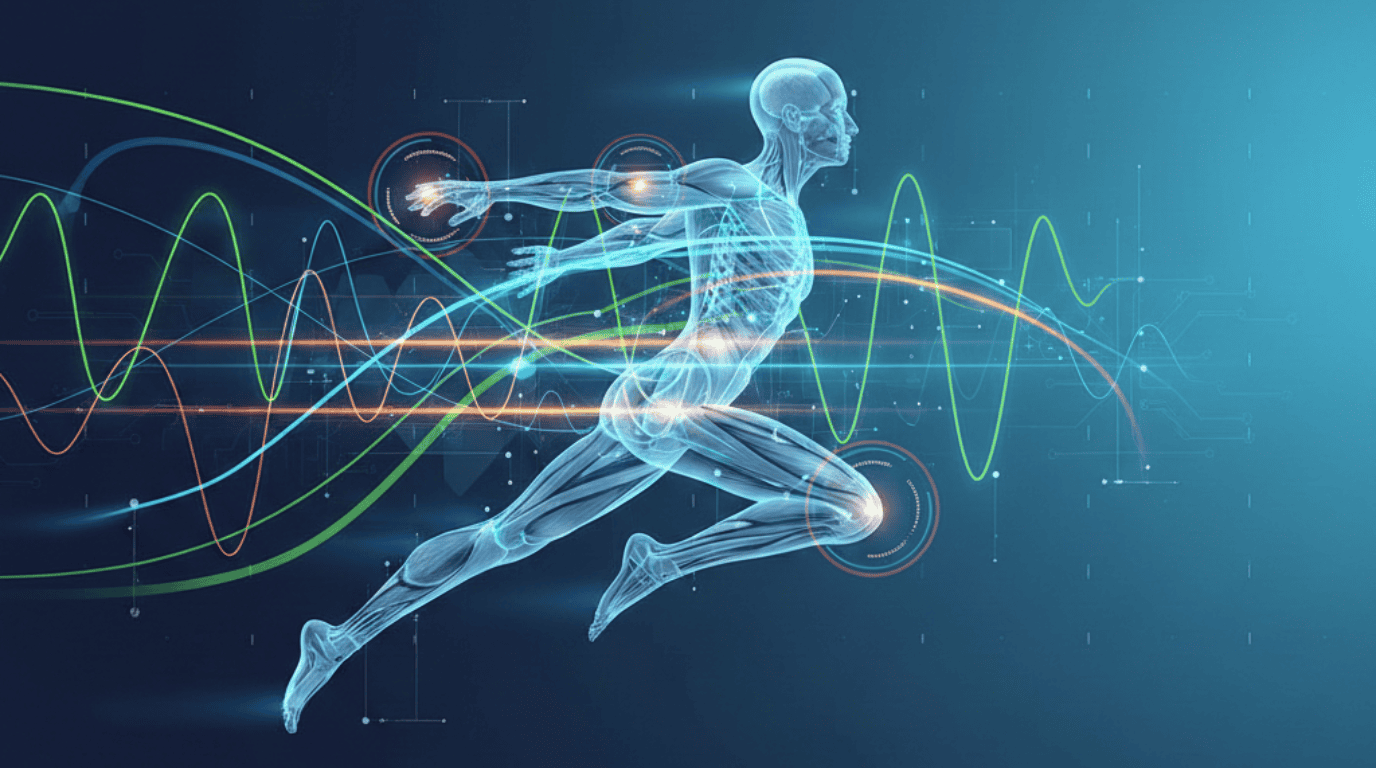
Turning Human Motion into Better AI: How Kinematics Improves Data Labeling and Model Quality
Using physics-based motion analysis to improve annotation accuracy, automated QC, and computer vision models.
Frank Tanner, VP of Computer Vision and Robotics
February 5, 2026
When most people hear “data labeling,” they picture someone clicking points on a screen all day. At Innodata, that’s only the starting point. We build labeling systems that capture structure, context, and motion, not just pixel locations.

Video from Wikimedia Commons, pose added by Innodata
In this post, I’ll walk through how we use the physics of motion—kinematics—to improve labeling accuracy for exercise and sports video, automatically detect annotation errors, and evaluate whether trained models are tracking motion realistically.
Beyond Dots on a Screen: What “Sophisticated Labeling” Means
At the core of many AI systems is labeled data: keypoints on a body, bounding boxes around objects, or trajectories over time. One of Innodata’s main lines of business is providing this kind of high-precision annotation at scale, including detailed keypoint extraction on people, animals, and objects.
But doing this well involves more than hiring a team of annotators and giving them a drawing tool. We design workflows and tooling that:
- Capture fine-grained structure, including joints, limbs, and equipment, using keypoints and skeletal representations.
- Enforce consistent definitions across thousands of clips so that each keypoint (for example, “wrist”) always corresponds to the same anatomical location.
- Integrate pre-labeling models and human-in-the-loop review to make annotation faster and more accurate.
That’s the foundation. The next step is understanding the motion itself.
Why Kinematics Matters for Labeling
Kinematics is the study of how things move: positions, velocities, and accelerations over time. For many types of video—exercise, physical therapy, and sports—this motion is the signal we care about.
If we understand the motion, we can move beyond frame-by-frame labeling and reason about the behavior itself:
- We can ask whether a movement “makes sense” for the activity (e.g., a smooth repetition versus a sudden jump).
- We can detect labeling mistakes automatically when the motion breaks the expected pattern.
- We can evaluate whether models trained on that data are tracking motion plausibly, not just optimizing a loss function.
In other words, kinematics turns raw labels into a structured description of behavior.
Example 1: A Smooth Triceps Press-Down
In one of our exercise videos, I perform a triceps press-down while we track keypoints on my arms and torso (this is my unofficial side gig as a middle-aged fitness model).
If you plot the vertical position of my hand or wrist over time, you see a motion that looks very close to a smooth, periodic sine wave: down, up, down, up, with no abrupt spikes.
Video and annotation information provided by Innodata
Why that matters:
- For this kind of exercise, we expect controlled, periodic motion with relatively constant tempo.
- A smooth curve tells us the keypoints are consistent across frames and the annotators (or models) followed the motion correctly.
- It gives us a reference pattern (a “healthy” signal) for that type of movement.
This simple example shows how combining labels with motion analysis gives us a sanity check: the data behaves the way the underlying physics of human motion predicts it should.
Example 2: Bench Press and Automatic Anomaly Detection
Now compare that to a bench press video we use, sourced from Wikimedia Commons and annotated using a pose extraction model. When we examine the keypoint trajectories, we sometimes see abrupt jumps in the wrist position—sudden changes that don’t match how a human actually moves during a controlled bench press repetition.
Video data from Wikimedia Commons, pose and kinematics added by Innodata
To make this concrete, we:
- Track the wrist position frame by frame.
- Compute the change over time. In mathematical terms, this is expressed as the first derivative of the position signal (𝑑𝑥/𝑑𝑡), which you can think of as the instantaneous speed of the point.
- Look for spikes where 𝑑𝑥/𝑑𝑡 suddenly becomes much larger than normal for a single frame.
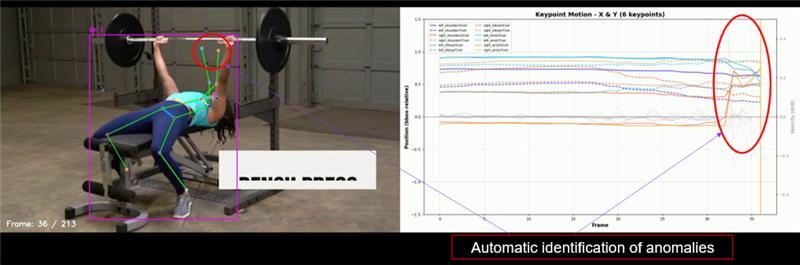
Those spikes are strong indicators of anomalies:
- They might be annotation errors (the point “snaps” to the wrong place for one frame).
- They might be model tracking failures (the model loses the wrist and re-acquires it incorrectly).
Instead of manually scrubbing through every video, our quality control tooling flags these suspect segments automatically. Human reviewers can then quickly confirm, correct, or re-label them, closing the loop between analytics and annotation.
Closing the Loop: Labels, Models, and Automated Quality Control
Innodata’s strength is not just in advanced labeling techniques but in using motion analytics as part of a continuous quality control loop.
Our approach ties together:
- Advanced annotation: high-quality keypoints, custom workflows, and domain-specific label taxonomies.
- Motion modeling: kinematic analysis (positions, velocities, and patterns over time) to describe how things should move in a given context.
- Automated anomaly detection: using measures like 𝑑𝑥/𝑑𝑡 (change over time) to flag suspicious labels and model outputs for review.
This combination lets us deliver datasets and models that aren’t just “labeled,” but physically coherent, statistically robust, and aligned with real-world behavior across applications ranging from fitness and sports to robotics and beyond.
Treating motion as a first-class signal is essential for AI systems that need to interpret how people or objects move. When labeling and quality control reflect the underlying physics of motion, teams can build models that perform more reliably in real-world conditions.
Innodata works with organizations building motion-heavy systems across fitness, sports analytics, robotics, and physical therapy. Our computer vision and robotics experts help design kinematics-driven labeling workflows, automated anomaly detection, and motion-aware evaluation pipelines that improve both data quality and downstream model performance.
To explore how this approach could apply to your use case, connect with an Innodata expert.

Bring Intelligence to Your Enterprise Processes with Generative AI.
Innodata provides high-quality data solutions for developing industry-leading generative AI models, including diverse golden datasets, fine-tuning data, human preference optimization, red teaming, model safety, and evaluation.
Follow Us